
Storey County 72-Hour Feed Status
Storey County does not publish a rolling 72-hour release view in the official Sheriff, Detention Facility, or county sitemap sources reviewed through July 28, 2026. No public list exposes a three-day range, booking-photo flag, field set, update cadence, or retention rule. It would be inaccurate to assemble a replacement from agency social posts, app notices, or names copied from another county.
The absence of a web feed is not the absence of county records. It means the inquiry shifts from browsing a public list to identifying the person, booking, and date span. Storey County’s public-record instructions say the agency need not research a request or create a new report. Ask for an existing booking and release record associated with a known person and approximate custody period.
Build a Storey County Window
A 72-hour inquiry is best treated as an evidence timeline. The detention desk gives a current snapshot. A release record supplies the county event. A court file can explain the legal basis, while a receiving agency can show that a departure was a transfer rather than release to the community.
- Define the exact three-day period in Pacific Time and record the start and end dates.
- Call Storey County detention at 775-847-0929 to determine whether the named person remains in local custody.
- Use the county public-record instructions to request the existing booking and release record for that person and range.
- Check the proper Storey court for an order, disposition, judgment, or sentence that explains the custody change.
- Review Nevada S.A.V.E. for a related event, while treating it as supplemental rather than certified proof.
- Follow NDOC, BOP, or ICE only when a Storey record or other evidence points to that custodian.
This process differs from a same-day status check. It focuses on preserving dates from multiple sources and resolving gaps across a longer period. For a check centered on the current day, use the Storey County 24-Hour Releases path.
Build the timeline one person at a time. Storey County has not published a field set that supports a countywide list of all releases across the period. If the request concerns more than one booking, identify each booking separately rather than asking staff to infer which custody events matter. A narrow request reduces ambiguity between a new booking, an old release, and a transfer recorded within the same three-day span.
Note: Use Pacific Time for the Storey event and label any source that presents a different time zone.
Storey County Three-Day Record Fields
There are no verified 72-hour feed fields to reproduce. The useful fields below are items a requester may seek in an existing Storey County booking and release record. They should not be described as columns on a public screen, and disclosure is not guaranteed.
| Field to request | Use within the three-day window |
|---|---|
| Name and known alias | Matches the record to the right person. |
| Booking number | Separates one custody episode from another. |
| Booking date and time | Shows whether the jail stay overlaps the period. |
| Release date and time | Places the end of Storey custody within or outside the range. |
| Release disposition or type | Uses the county’s maintained term for the event. |
| Receiving agency or destination | Points to the next custodian when maintained. |
| Associated charges | Links the booking to the relevant court matter. |
A precise request might ask for the booking and release record for a named person during the stated range, including the booking number, timestamps, disposition, destination if maintained, and related charge identifiers. Electronic delivery can be requested. Avoid unnecessary sensitive personal data in an emailed submission.
The record’s own wording controls. Common concepts such as bond, time served, sentence completion, court order, or transfer describe possible paths, but Storey County’s exact internal codes were not published. Do not ask staff to force an event into a guessed label. If the response uses “transfer,” “hold,” or names a receiving agency, continue the inquiry there and avoid describing the person as released to the community.
Storey County Weekend Release Timing
No official source gives Storey County release-processing hours, weekend or holiday procedures, an exit door, or a family waiting area. Therefore, a 72-hour check should not assume that a weekend event will appear in a Monday web update. There is no Storey web feed to update. Call detention for the current status and request the underlying record for the exact event.
A court order time may differ from the physical exit time. Staff may need to verify identity, check other holds, complete paperwork, or carry out a transfer. A notification can also arrive after an agency event is entered. These distinctions are why a three-day timeline should preserve every source and label rather than selecting the earliest timestamp as “the release.”
Local sentence completion presents another timing issue. The court’s judgment states the imposed sentence and any credit ordered by the judge, while the jail record states when Storey custody actually ended. No verified Storey County jail good-time formula was found. NDOC state-prison credit rules must not be copied into a local misdemeanor calculation. Obtain the commitment, court order, and jail event record as separate documents.
| Timestamp | What it may mean |
|---|---|
| Court order time | The judge authorized or directed an action. |
| Jail release time | Storey custody ended under that booking. |
| Transfer time | Custody moved to another agency. |
| Alert time | The notification system transmitted an event. |
Storey County’s court calendar can help identify a hearing that occurred in the period, but a calendar is not proof of release. The docket and actual order are stronger. The Virginia Township Justice Court handles local criminal and misdemeanor matters. The First Judicial District Court handles felony and general-jurisdiction matters.
Storey County Archival Release Request
A three-day request may take longer than a telephone status check because it seeks a preserved record. Nevada’s public-record framework requires an agency response by the end of the fifth business day that produces the record, says it lacks custody and identifies a known custodian, gives written notice of delay and an estimate, or denies access with the confidentiality authority. This framework is not a promise that every requested record will be produced within five business days.
Storey County publishes no sheriff-specific release-record fee or booking-photo charge. It also does not publish a fixed retention term for all jail release records. The county follows the applicable local-government schedule and says records without an approved matching schedule are retained indefinitely. That statement cannot be converted into a promise that each jail record remains available forever.
The official NDOC records page is a separate route for people transferred to Nevada state prison. The captured page below shows the state-level records fallback, not a Storey County 72-hour list.
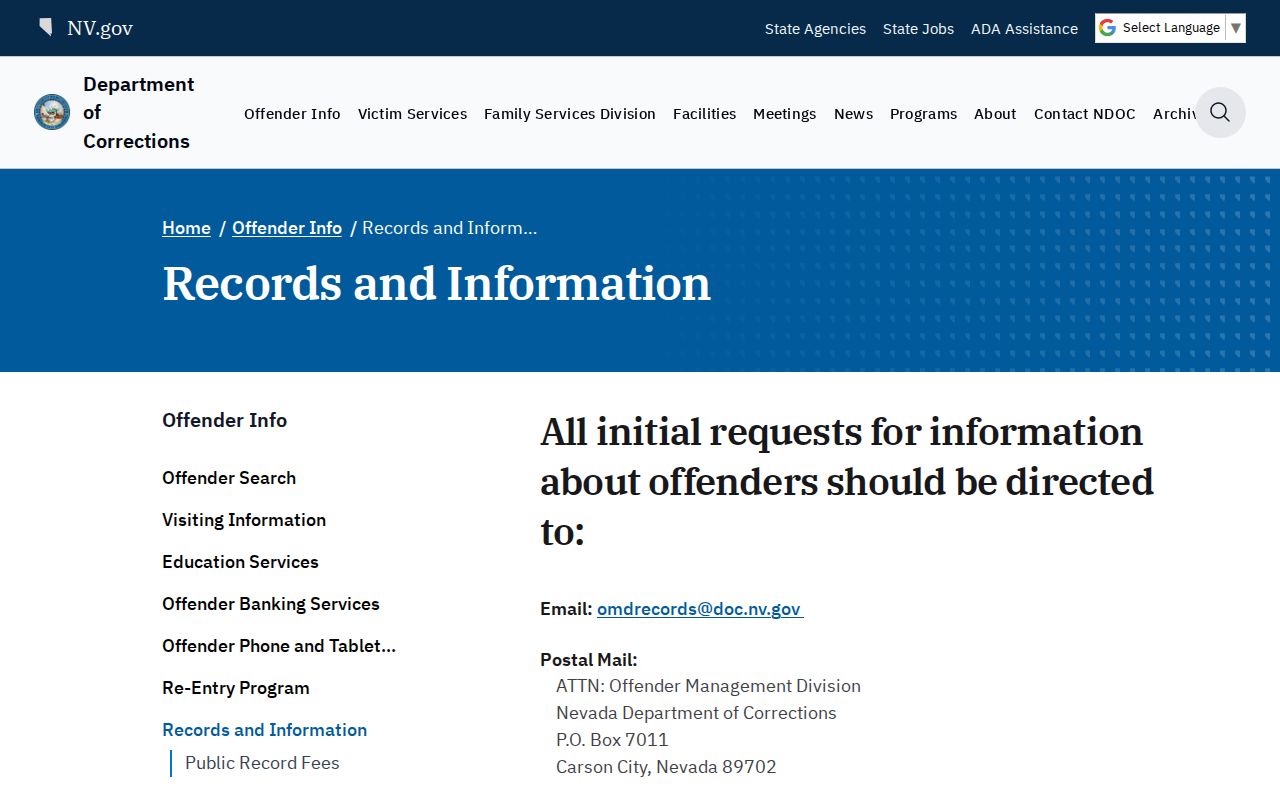
Use NDOC only after the evidence supports a state transfer. A person released from Storey County on local bail or after a local sentence may never appear in the NDOC system.
When NDOC applies, match the Offender ID and booking ID instead of relying on a name. The state release dataset can expose a release date and description, but NDOC calls its web data raw and unofficial. It may locate the event, while an official Offender Management record provides stronger confirmation. A prison release to parole also differs from discharge because NPP supervision can continue after the person leaves the institution.
Storey County Release Status Differences
“Released” answers only what happened under a particular custodian. A Storey County jail exit can be a community release, conditional pretrial release, sentence completion, or transfer. A state-prison release to parole ends confinement in the institution but starts or continues NPP supervision. A federal BOP result applies only to BOP custody. ICE’s locator is primarily a present-custody tool, not a release archive.
- Community release
- The person leaves jail custody without an immediate transfer shown, though court conditions or another form of supervision may continue.
- Transfer
- One agency ends custody because another agency takes it.
- Parole
- A person leaves prison under Board jurisdiction and NPP supervision.
- Discharge
- The relevant sentence or supervision obligation ends as shown by the responsible agency record.
The Storey County released inmate lookup provides the custody-specific route for one named person when the responsible system is unclear. Never treat a missing name as proof of freedom. Spelling, aliases, data lag, sealing, juvenile confidentiality, and system coverage can all affect a search.
Juveniles remain outside this adult process. County material says they are housed at a juvenile facility in Carson City, but those records use distinct systems and are commonly confidential. The lack of an adult Storey result should never be used to infer a juvenile placement or release.
Storey County Three-Day Notifications
Nevada S.A.V.E. may provide an event within the three-day span and is useful for reconstructing the sequence. Still, the alert is supplemental. Confirm the source agency, event description, and destination. Nevada changed from legacy VINE to S.A.V.E. in 2025, so older VINELink directions may be stale.
A S.A.V.E. event can follow a person across participating Nevada custody and supervision agencies, but it does not cover every federal or immigration system. It also does not replace separate records held by Storey County, NDOC, NPP, or a court. If an alert and an oral status answer differ, preserve both times and request the responsible agency’s underlying event record rather than choosing the result that seems most recent.
The current NDOC notification instructions show the state notification route. Their captured page appears below.
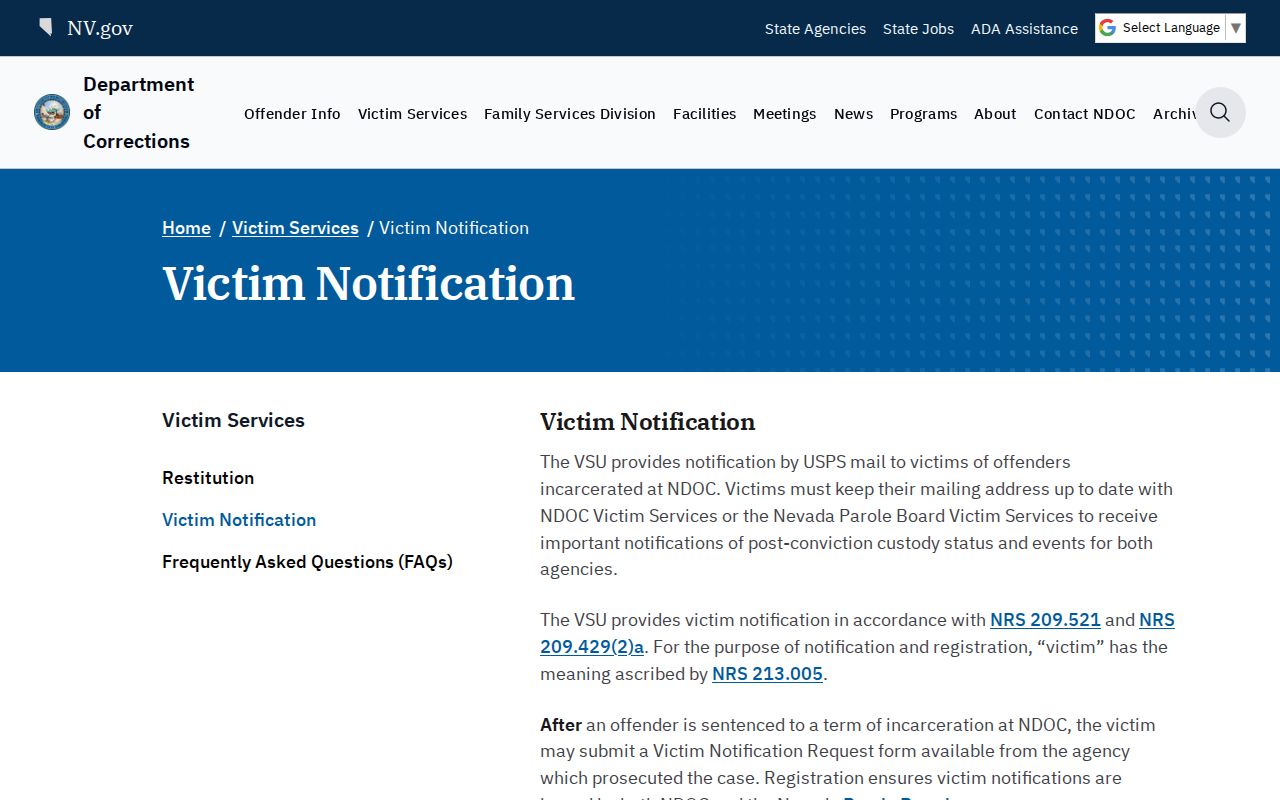
The image documents a notification channel, not a certified county release list. Match any event with the Storey record, court order, or receiving agency evidence.