
Storey Release Dates Are Conditional
A projected date is a calculation based on facts known at the time. An actual release date records what occurred. A pretrial detainee often has no sentence-based exit date because release depends on bail, a court order, case disposition, or another agency’s hold. A sentenced county inmate may have an expected end date, but Storey County publishes no verified local calculation formula.
A Storey transfer record can end county custody without freeing the person. If the destination is NDOC, the state record becomes the next source. A detainer is another agency’s request to hold or receive someone, and it can turn an expected community release into a transfer.
Find Storey County Release Dates
Choose the path based on the person’s present or last known custodian. Storey jail staff can address present custody, but a historical date is best supported by the booking and release record. Courts explain the legal order. NDOC manages state-prison calculations.
- Call Storey County Detention Center at 775-847-0959 to ask whether the person remains in local custody.
- For a county sentence, request the booking and release record and consult the Justice Court or First Judicial District Court file for the judgment and credit ordered.
- For a state prisoner, use the NDOC offender search. Match the Offender ID and booking ID, not just the name.
- Copy the exact date label and status shown. Do not rename an unexplained abbreviation.
- If parole is involved, compare the NDOC record with the Board action and NPP placement status.
- Confirm a completed release through the official jail or NDOC record. A Nevada S.A.V.E. notification is a useful alert, not certification.
The Storey County released-inmate search provides the custody-specific path when the holding system is unclear. For an old local event, file an identifiable county request rather than assuming that a blank web search proves release.
NDOC Storey Release Date Fields
NDOC’s public downloads provide detailed sentence and release fields. They are raw data, and the portal warns that they are not official records or guaranteed error-free. The release dataset ties an event to an Offender ID and booking ID. The booking data contains sentence components and four abbreviated date fields that the public form does not define.
| Field | Verified meaning or limit |
|---|---|
offender_id | Identifier used to match one person |
offender_book_id | Related prison booking |
release_date | Date attached to the release event |
release_desc | Agency description of that event |
sent_min_yrs/mths/days | Minimum sentence components |
sent_max_yrs/mths/days | Maximum sentence components |
sent_ped, sent_mpr, sent_pexd, sent_rrd | Abbreviations whose official expansions were not verified |
Do not call one abbreviated field the projected release date without a live label or an NDOC definition. Request a data dictionary or sentence-management record from Offender Management when precision matters. Preserve odd source text as written, including an apparent “TRANSER TO PAROLE” typo, while explaining that it does not prove unconditional discharge.
The NDOC records office handles official follow-up. Initial questions go to omdrecords@doc.nv.gov or Offender Management Division, P.O. Box 7011, Carson City, NV 89702.
Nevada Credits Change Release Dates
NRS 209.4465, in the version effective through June 30, 2027, generally covers offenses committed on or after July 17, 1997. A compliant offender receives 20 days of credit for each month served. The Director may allow up to ten more days per month for diligence in labor and study. Education, treatment, program, and meritorious credits may also apply.
For many Category A and B felonies committed on or after July 1, 2014, credits cannot reduce the minimum or aggregate minimum by more than 58 percent. Some serious offenses have stronger limits or exclusions. The law version tied to the offense date controls. Credits may also be forfeited or restored under NRS 209.451.
The official Nevada sentence-credit statute provides the controlling text and its offense-specific limits.
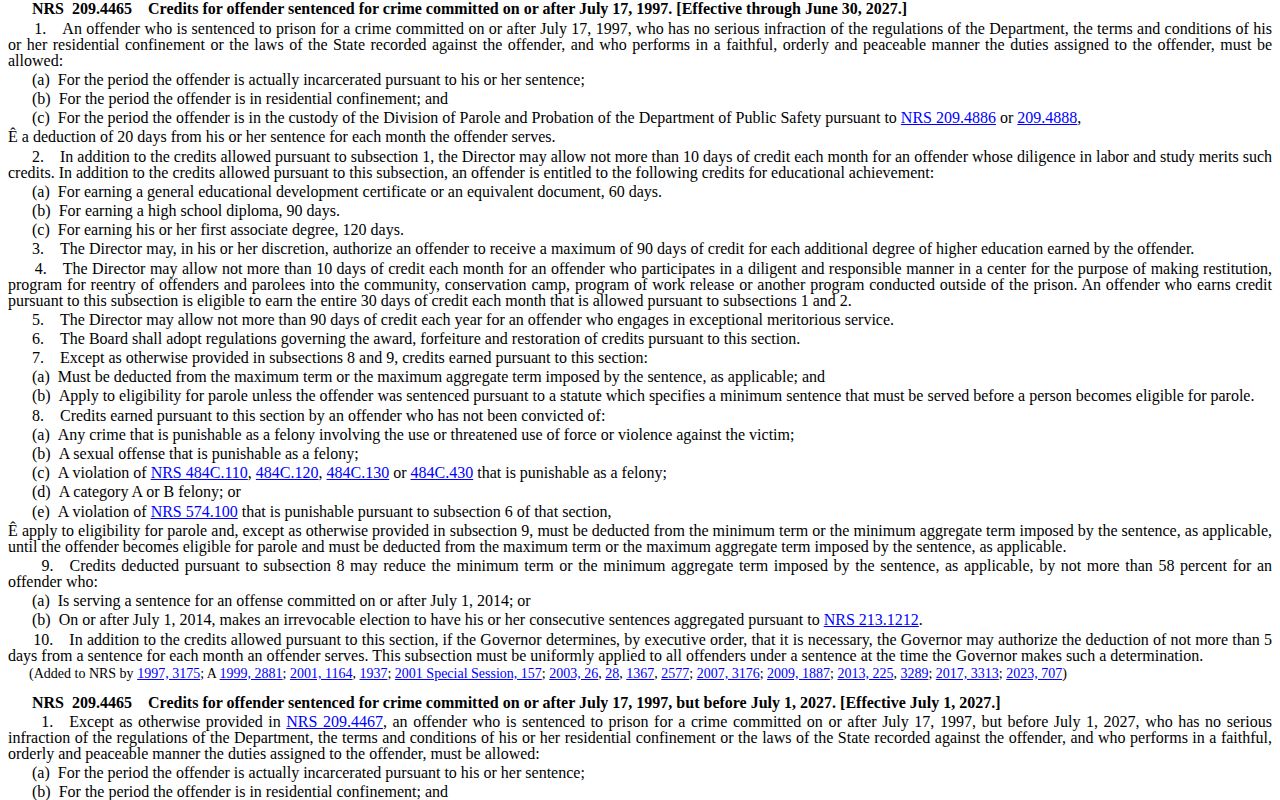
The statute must be read with the offense date and judgment rather than used as a flat release-date calculator.
Nevada did not adopt a universal rule requiring each person to serve exactly 85 percent. The effect varies by offense, sentence date, minimum term, and exception. A broad percentage estimate is unsafe.
Note: NDOC state-prison credit rules should not be copied onto a Storey County jail sentence.
Why Storey Release Dates Move
Sentence dates can change for lawful and practical reasons. The agency may recalculate credits, receive an amended judgment, aggregate consecutive terms, or identify a hold. Parole adds a second layer because eligibility and a favorable decision do not guarantee immediate placement.
| Change | Possible effect | Best record |
|---|---|---|
| Credit earned or restored | May reduce a qualifying maximum | NDOC sentence record |
| Credit forfeited | May move a projected date later | NDOC disciplinary and sentence record |
| Amended court order | Can alter the controlling sentence | Filed judgment |
| Consecutive terms | May be aggregated | Judgment and NDOC calculation |
| Placement review | Can delay release after a parole grant | NPP Pre-Release Unit |
| Detainer or warrant | May cause custody or transfer | Holding and receiving agencies |
When dates conflict, ask what each marks. It may be an order, eligibility, projected expiration, transfer, or actual release. Storey County and Nevada agencies use Pacific Time, so preserve the time zone.
Storey Parole Dates Differ
Under NRS 213.120, a person convicted of a crime committed on or after July 1, 1995, generally becomes eligible after serving the court-imposed minimum or aggregate minimum. Offense-specific statutes may change that baseline. Credits normally reduce the maximum rather than the minimum except where Chapter 209 allows otherwise.
Eligibility means the Board may consider release. It is not a grant. A Board grant is a decision, not the gate event. NPP’s Pre-Release Unit must verify and approve placement, and another hold may control the next destination. Mandatory parole under NRS 213.1215 is a distinct label for certain eligible prisoners and has exceptions.
NDOC, not the Parole Board, calculates eligibility and expiration. Pair the exact NDOC date with the Board action and NPP record instead of merging them.
Storey County Jail Date Limits
No verified Storey County jail good-time formula was found. For a local misdemeanor sentence, the court judgment states the imposed term and credit awarded by the judge. The jail record states when physical custody ended. One does not replace the other.
Time served is credit for custody already completed. It may cause release soon after disposition, but an unrelated warrant or hold can prevent a community exit. Ask the jail for its existing calculation or release record and the court clerk for the filed order. Do not use the NDOC formula as a shortcut.
Justice Court handles local misdemeanor and many pretrial matters. First Judicial District Court handles felony and general-jurisdiction cases. The county’s general “Search Records” page does not cover criminal cases, and Nevada appellate portals are not a statewide trial-court search.
Confirm Storey Actual Release
For a county exit, the strongest evidence is the booking and release record tied to the booking number. A court order may authorize release before jail processing ends. A phone answer is current but may not preserve a historical timestamp. Ask whether the event was release to the community or a transfer.
For state prison, the official NDOC release, discharge, or sentence-management record is stronger than the raw-data download. If parole follows, an NPP discharge record later proves when supervision ended. Those dates can be far apart.
A missing result carries little weight. Check spelling, aliases, IDs, transfers, sealing, and system coverage. Storey County has no public online jail roster, so there is no local web-search failure that proves a person is out.
Request Storey Release Date Records
When the public tools do not settle the date, ask for a narrow existing record. For Storey County custody, identify the person, approximate booking period, booking number if known, and the specific fields needed. Useful fields include actual release date and time, release description, disposition, and destination or receiving agency. The county’s public-record process is for identifiable records, not open-ended research.
A court record answers a different question. The judgment shows the term imposed and credit ordered. A bail, dismissal, amended judgment, or time-served order can explain why release was authorized. Yet it may be entered before detention staff finish processing. Ask the Justice Court or First Judicial District Court clerk for court material because the county request page expressly separates court records from general public requests.
For NDOC, preserve the Offender ID, booking ID, exact date label, and release description at issue. Offender Management is the better contact for sentence substance. The Public Information records route serves public-copy requests. NDOC lists publicrecords@doc.nv.gov and 775-977-5649, with inspection hours Monday through Friday from 8 a.m. to 5 p.m. Its published fees include 15 cents per paper page, actual removable-media cost, and five dollars for a CD or DVD recording. Extraordinary personnel or technology work may require payment in advance.
If an agency asks for clarification, narrow the date range and identifiers. If it does not hold the record, ask whether it knows the custodian. Preserve a written estimated production date or the legal reason for denial. The safest final timeline names each source and keeps a projected calculation distinct from the physical release event.
Retention and access can also affect an older Storey County release date lookup. A sealed court matter may no longer appear through a public channel, and juvenile information follows separate confidentiality rules. That result means the material is not public through the channel searched. It does not prove that no custody event occurred. When a record is withheld, keep the written reason and ask whether a narrower request for a nonconfidential release field can be processed.
For a transferred person, follow the receiving agency rather than stopping at Storey’s exit date. The county date may show only when local custody ended. NDOC, BOP, or another custodian may then hold the person. The final community release must come from that later system. This custody chain is vital when a court order and county record are correct but do not answer when confinement as a whole ended.