
Storey County VINE Is S.A.V.E.
Nevada S.A.V.E. is the current statewide portal. Storey County Sheriff links to it from the official sheriff page. Nevada replaced VINE and VINELink in 2025, so old instructions that tell users to begin a fresh VINELink registration are stale. The present system is offender-based, meaning one registration can follow an offender across participating Nevada criminal-justice custody and supervision agencies.
Legacy VINE used incident-based registration. It was free, anonymous, available around the clock, and supported phone, email, and text notices for events such as transfer, release, or escape. Those facts explain older “VINELink Storey County” results. They should not obscure the current path at Nevada S.A.V.E.
S.A.V.E. can cover participating Storey County, NDOC, parole, and probation feeds. It does not cover federal BOP or ICE custody. Its data is supplemental under Nevada law, so the source agency remains responsible for an official record.
Search Storey County S.A.V.E. Records
Search one person at a time. Use the most exact identity details available and compare the source agency before relying on the match. A common name by itself is weak evidence.
- Open the official Nevada S.A.V.E. portal.
- Search by first and last name or by the offender identifier offered by the live interface.
- Review possible matches. Compare age or date of birth, sex, race, photo, and the reporting agency when those fields appear.
- Open the correct record and read the current custody or supervision event in the context of its source.
- Note the event type and time. Do not convert a transfer into release to the community.
- Confirm with Storey detention, NDOC, NPP, or the court because the alert is not an official release record.
If a match is missing, try spelling variants and known aliases. Then check the custody system. Storey County does not publish an online jail roster, while NDOC has a separate offender search for state prisoners. The Storey County released-inmate lookup explains those distinct routes.
Storey S.A.V.E. Release Fields
The live record can provide identity and event details received from a participating agency. Availability varies by source. Read the exact labels rather than assuming every person has a projected date or full history.
| Field | How to use it |
|---|---|
| Name and alias | Compare spelling with the jail, court, or NDOC record |
| Offender identifier | Use it to separate similar names where available |
| Source agency | Shows which participating Nevada agency supplied the event |
| Custody or supervision status | Describes the current reported state, subject to update lag |
| Event type | May describe release, transfer, escape, or another custody change |
| Event date or time | Records the alert event, which may differ from a court order time |
A release alert does not always mean freedom from all custody. The person may transfer to NDOC or another agency. A prison release to parole also begins supervision rather than ending the sentence. Ask the source agency for the release description and destination when the wording is unclear.
The Nevada Attorney General’s legacy VINE material helps explain older search results.
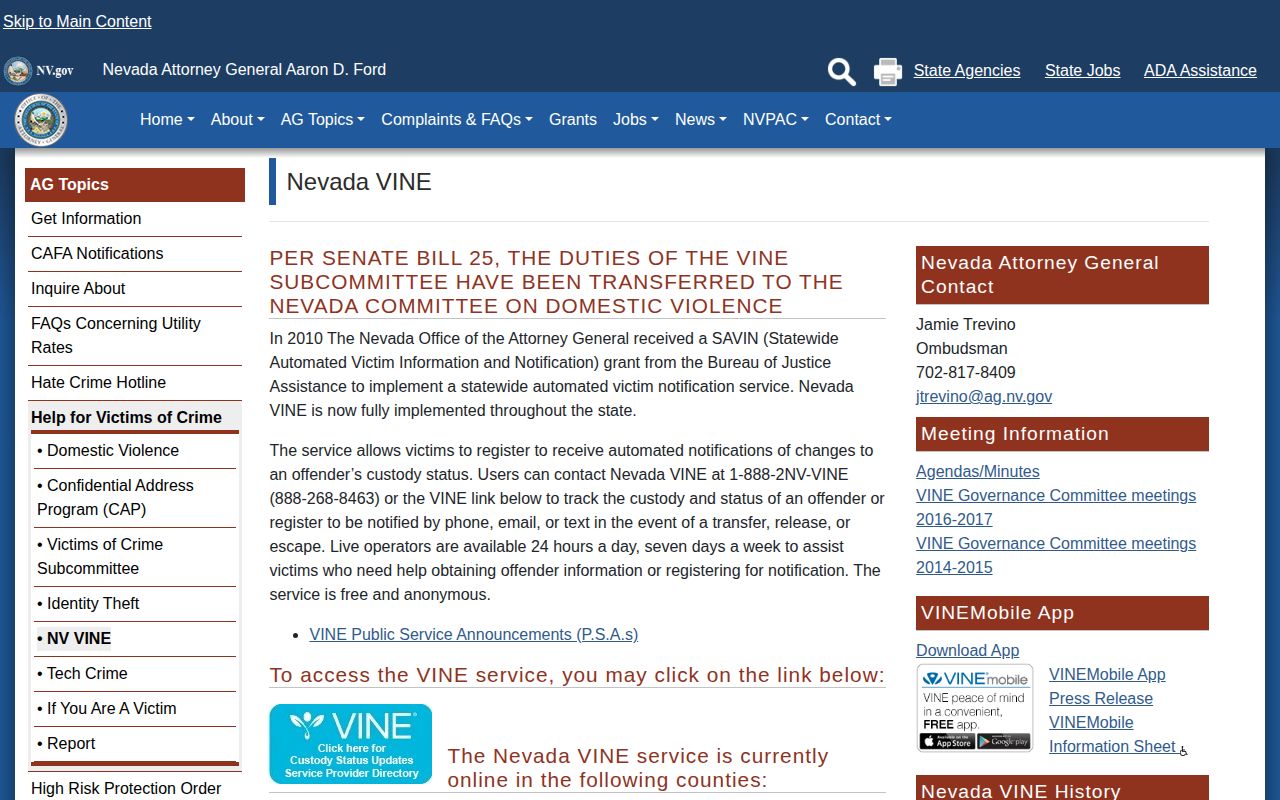
The older state page should be read with the 2025 S.A.V.E. transition, not used as the current registration gateway.
Register Storey County Release Alerts
Registration follows the live S.A.V.E. workflow. Current official materials reviewed for Storey County do not document the old four-digit VINE PIN. A PIN belonged to legacy telephone workflows. It would be inaccurate to invent one for the new portal.
- Find and open the correct offender record in S.A.V.E.
- Select the notification option shown for that record.
- Choose an available delivery channel, such as phone, text, or email, as offered by the current interface.
- Enter the requested contact details and follow the exact confirmation method displayed.
- Save the registration details and keep contact information current.
- When an alert arrives, verify it with the agency named as the event source.
If the confirmation step is unclear, call S.A.V.E. assistance at 1-866-393-5445. The line is listed as available 24 hours a day. Do not substitute old PIN instructions for what the current interface actually requests.
S.A.V.E. does not replace separate mailed victim registration with NDOC or the Parole Board. NDOC Victim Services uses NDOCVictimServices@doc.nv.gov. Parole Board Victim Services uses ParoleBoardVictimServices@parole.nv.gov.
Storey VINE Check Limits
S.A.V.E. is a notice channel. It is not a certified Storey booking and release record or an official NDOC sentence record. Updates can lag, and an alert time can differ from a court order, transfer, or physical exit time. Preserve the timestamp and source agency when records conflict.
The service does not track BOP or ICE detention. Use the BOP locator for federal imprisonment and ICE ODLS only when evidence supports an immigration handoff. No result in either system is not proof of release.
A S.A.V.E. result also does not prove that parole or probation ended. For that, request the NPP discharge document and expiration or discharge date. The NPP records page provides that route.
Storey VINE Registrations Changed
The 2025 transition treated prior users differently. According to the Nevada Attorney General’s transition notice, many people registered through the legacy website or telephone system carried over without registering again. People who had registered only through the VINE mobile app had to take action.
That distinction is especially relevant in Storey County because the sheriff now links the current S.A.V.E. gateway even though the county has no public recent-release feed. An old app registration should not be assumed active. Use the current portal or help line to verify registration status.
The switch also changed the model. One offender-based registration can follow a person through participating Nevada agencies, instead of requiring a separate incident-based registration each time. Agency confirmation remains necessary because the alert supplies notice, not a certified history.
Storey Release Alert Routes
For a local bail or pretrial release, start with the Storey detention desk and the county booking and release record. The court file can show the order that authorized release. S.A.V.E. may help with timing, but an oral “not here” answer or alert alone is not historical proof.
After a felony transfer, the Storey event marks the end of county custody while confinement continues in NDOC. Later NDOC release data, Board actions, and NPP records describe separate stages. Match the Offender ID and booking ID through the chain.
For a probation discharge, the court and NPP are the key sources. NDOC may have no record if the person never served a state-prison sentence. This system-specific approach prevents a correct alert from being used to answer the wrong custody question.
Resolve Storey Alert Conflicts
An alert, phone statement, court order, and release record can carry different times without any one source being false. The court may record when release was authorized. S.A.V.E. may show when an event reached the notification system. Detention records can preserve the actual local exit or transfer. Ask what each timestamp represents and keep Pacific Time attached to Storey and Nevada events.
If an alert says release but the jail says the person is still present, record both times and ask detention staff for the existing event record. A processing delay or corrected feed may explain the conflict. If the jail says the person left but the alert has not arrived, confirm the destination. A transfer to NDOC, BOP, or another agency is not the same as release to the community.
For an NDOC event, compare the public release date and description with the official sentence-management or release record. The public download is a good locator but is raw and unofficial. A Board action proves a parole decision, while NPP proves supervision. A phrase such as transfer to parole means prison custody ended and parole began. It does not mean the full sentence or all oversight ended.
Missing results also require care. Check aliases, spelling, identifiers, custody system, timing, and lawful sealing or confidentiality. Storey has no public online jail roster, so there is no official local name-search result to interpret. A blank S.A.V.E. search should be described only as no match through that channel.
Confirm Storey Release Notices
Storey County Detention Center is the first contact for current local custody at 775-847-0959. Historical proof comes from the county booking and release record. A court file may explain bail, dismissal, sentence completion, or another legal basis, though it may not show the exact moment of exit.
For a state prisoner, use the NDOC offender search and then contact Offender Management at omdrecords@doc.nv.gov when official confirmation is needed. For the end of parole or probation, request the discharge record from NPP. These direct sources should close the loop after a S.A.V.E. notice.
Victim notification and formal records serve different needs. S.A.V.E. provides prompt awareness. The agency record preserves the event. Keeping both lets a person act on a notice while avoiding claims that go beyond the source.
Keep the offender identifier, source agency, event label, and notification time together. Those details make later confirmation far more reliable than a screenshot of a name alone. If the person has moved between agencies, ask each custodian about only its part of the timeline.